

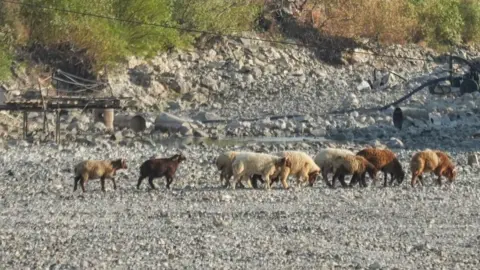
Close to the countryside by the city of Hama, wheat fields are expected to be golden and productive with harvest.
However, one agriculturist's plot lies unproductive, generating just a third of its normal yield.
"The current season was disastrous due to the water crisis," remarked the middle-aged grower.
His fields generated merely 190kg per unit—well under the 400-500kg seen in a average season.
"{We did not recoup what we put in; we've suffered financially. I can't afford next season's crops," he emphasized.
With a pair of growing family members to support, he is relying on money from kin to get by.
Countrywide Emergency
This hardship is echoed throughout the nation, where the gravest drought in 36 years has slashed wheat harvests by nearly half.
An anticipated deficit of 2.73 million tonnes looms this year—representing the yearly food requirements of more than 16.25 million people.

Increasing Hunger
Lacking increased support or the means to purchase grains, the crisis may deteriorate significantly.
Over 14,000,000 people—around six in ten the people—presently find it hard to eat enough.
Out of these, 9.1 million experience acute food shortage, with a significant number in extreme states.
Rainfall has dropped by about 70%, damaging three-quarters of rain-fed farmland.
"This means the difference between families being able to stay in their communities or having to migrate," noted an representative.
Daily Struggles
Farming families are selling animals to supplement diminished earnings, cutting back their daily diet.
Undernourishment cases among minors and expectant mothers are increasing.
Wheat is a staple food in Syria, used for loaves and noodles—cheap foods that are now becoming more expensive in value.
In the case of a widow aged 39, purchasing staples has become very challenging.
With several children, she relies on her older sons' wages, which fall short of essential costs.
"Occasionally we borrow funds just to purchase food," she shared.
Earlier, a portion of bread was priced at 500 money, but today it is 4,500.
For her family, it takes two portions a daily—a financial burden of 9,000 currency units, before other food.
Official and International Efforts
This crisis creates a significant challenge for the government, which is striving to reconstruct the nation after years of unrest.
Aid agencies are supplying financial help for those at risk, but representatives note that these are temporary solutions.
"The goal is to enable agricultural workers in the farming field," commented a representative.
Financial support have been provided to agricultural families who lost the whole harvest.
Yet, after years of war, Syria's agricultural system was already damaged by economic collapse, broken irrigation systems, and contaminated land.
Water Shortage
Within vital agricultural zones, crop fields need numerous irrigation cycles per growing period, but due to shortage of rain, many growers are unable to manage.
"The grower's main worry is securing resources," said a local official.
Water depends on diesel, and expenses have skyrocketed sharply, reaching eleven thousand to 12,000 pounds per litre.
High fuel prices and ongoing power cuts have left water pumps inaccessible for most farmers.
Long-Term Solutions
One focus for the administration is developing water infrastructure—like solar-powered drip systems—to provide resources more available.
But these initiatives take time and money—options that wheat farmers do not have right now.
Thus, for countless citizens across the nation, there is just one option to rely on in the coming period: pray for rain.

